The Ghost in the Machine
How conscience survives when truth is negotiable.
I went to Tulsa for its ghosts and found two of America’s loudest consciences waiting for me on the same block. Originally, my focus for living in Tulsa was to visit Greenwood Rising to learn about a racial massacre that our American history textbooks turned into a footnote. I was expecting a lesson in burial, but Tulsa handed me a lesson in the anatomy of resistance.
Twice, the city interrupted my plan and said, “Here’s how people kept truth alive when it wasn’t convenient.” Today’s headlines numb us, and those in power want subjugation or silence. But conscience doesn’t survive because it’s convenient. It survives because people build machines that keep it alive, even when the truth is under siege.
Like many of you, I struggle to process all that is happening in America these days. There are times when I struggle to recognize America in the bitterness of social media discourse and mainstream media broadcasts. Especially now, after the killing of Renee Nicole Good by ICE agent Jonathan Ross in Minneapolis on January 7th, and the immediate gaslighting by the members of the Trump Administration. Vice President J.D. Vance publicly defended the agent and cast blame outward and downward, making it not just an incident but a political test. Homeland Security Secretary Kristi Noem doubled down on the department’s self-defense framing and vowed to send in “hundreds” more agents. Public speech from government officials is being used to subvert the truth, shape the narrative before facts fully emerge, defend contested actions, and reframe accountability as justification.
And President Trump has not only attacked Good but has now raised the specter of the Insurrection Act of 1807 to send the military into Minneapolis to crush the protests from thousands in the street. The Machinery of State versus the Machinery of Conscience.
This Land is Your Land
In the Tulsa Arts District, at the corner of Reconciliation Way and Boston Avenue, there’s a building-high mural of Woody Guthrie outside the Woody Guthrie Center. It’s painted on an old warehouse that once operated as the Tulsa Paper Company, a place that stored and supplied rolls of newsprint for area newspapers. The irony is almost too clean: a former paper warehouse now holding an archive dedicated to the machinery of dissent.
Guthrie’s guitar is there in the mural, too, with a warning that refuses to age out: “This Machine Kills Fascists.” In my head, I used to treat that as a slogan from another America. Tulsa made it feel like an instruction manual.
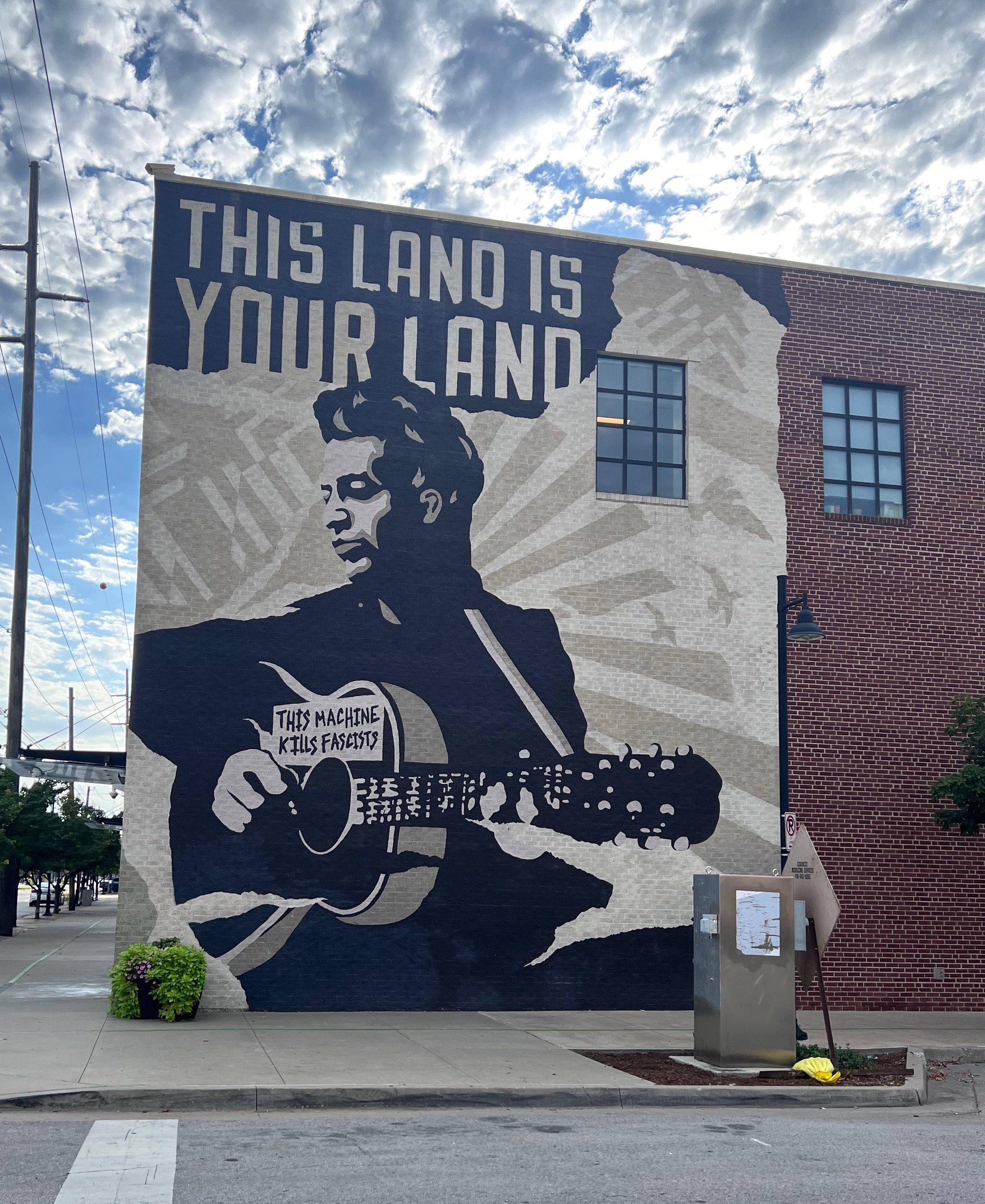
“This Land Is Your Land” Mural, Woody Guthrie Center, Tulsa Arts District, Tulsa, OK (Michael Holland)
I first found Guthrie secondhand, through Bruce Springsteen’s live performances of “This Land is Your Land.” But the song itself is not a lullaby. Guthrie wrote it as a rebuttal, a critical response to Irving Berlin’s “God Bless America,” because he couldn’t stand how the patriotic story was being sung as if it were complete.
His travels gave him a different vantage point. During the Dust Bowl and the Great Depression, he watched families pushed west by drought and poverty, then welcomed into California with a slur. “Okies,” no matter which state they’d come from. He watched the country treat internal migrants like invaders, including efforts to block “undesirables” at the California state line in what came to be known as the “bum blockade.”
He wrote into that reality. He made it portable. He made it singable. Seeing Guthrie’s lyric drafts reveals a mind that never stopped moving, a man who believed silence was a form of complicity.
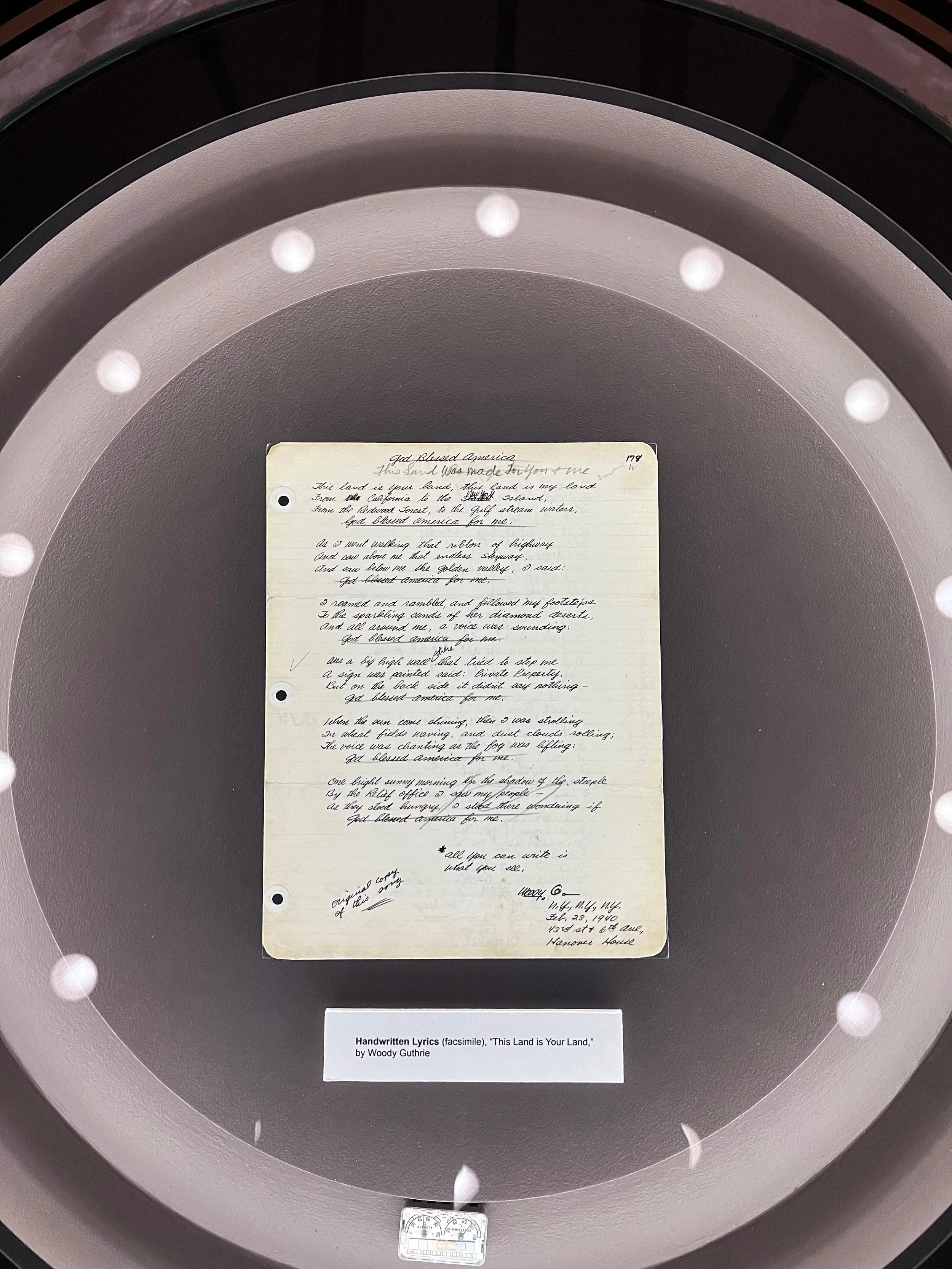
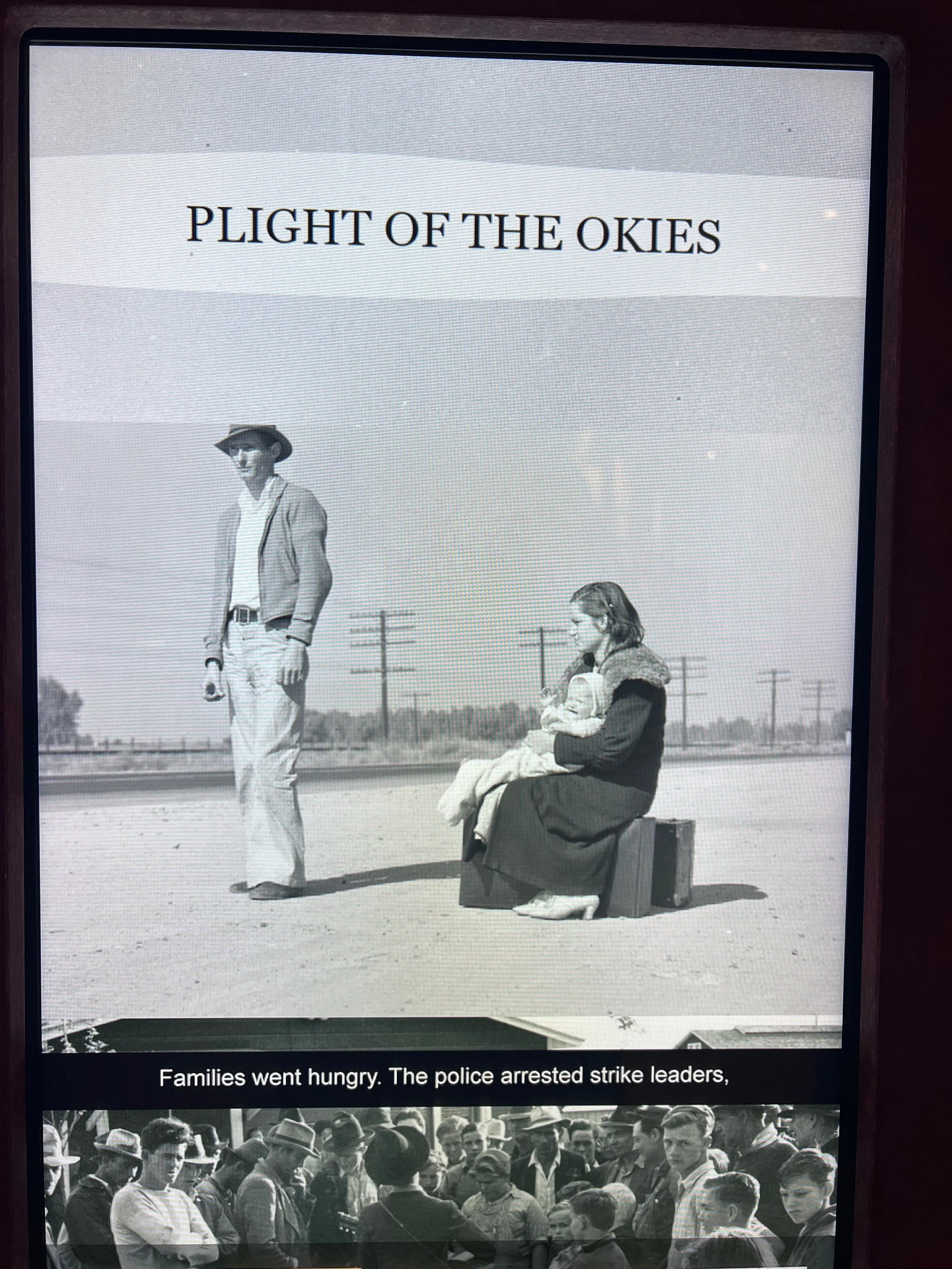
At the Guthrie Center, “This Land Is Your Land” is not just a concept; it is a sheet of paper: handwriting on a worn page, held in place behind glass, lit like evidence. You can see the human scale of conscience, the way a national argument can begin as pencil marks, as a chorus someone was stubborn enough to write down. A few steps later, the story turns into documentation. A museum exhibit on the “PLIGHT OF THE OKIES,” how families went hungry, were displaced, and how the police arrested strike leaders. The parallels to America 2026 are undeniable.
An’ we gazed upon the chimes of freedom flashing
And Tulsa does not just preserve Guthrie. Next door, the Bob Dylan Center holds another body of work built to outlast convenient forgetting. Two conscience-keepers, housed on the same block, as if the city is daring you to ask the obvious question: do you have the courage to build a language for what you’ve seen?
Like Guthrie, I came to Dylan secondhand through Bruce Springsteen. Hearing his live version of “Chimes of Freedom” was the moment I realized some songs are not songs. They confront you. They move through you. They reorient you.
Dylan is not simply “protest music.” He is a witness trying to build a language sturdy enough to hold what the country keeps doing, but calling it by nicer names.
“Chimes of Freedom” is a catalog of the overlooked. The people the headlines step over. The ones power is always asking us to forget in exchange for keeping the peace. It is a hymn for the bruised, the cornered, the disappeared, the publicly blamed and privately buried. It refuses the lie that suffering is random. It refuses the lie that brutality is a one-off. It insists that the vulnerable are not a footnote; they are the recurring subject.
The Dylan Center makes that insistence visible in a way the streaming version never can. Drafts. Cross-outs. Renumbered verses. Words scratched away like they could not be trusted until they were earned. The machine is not only inspiration. The machine is revision. The machine is a man refusing to let the easy line stand in for the true one.
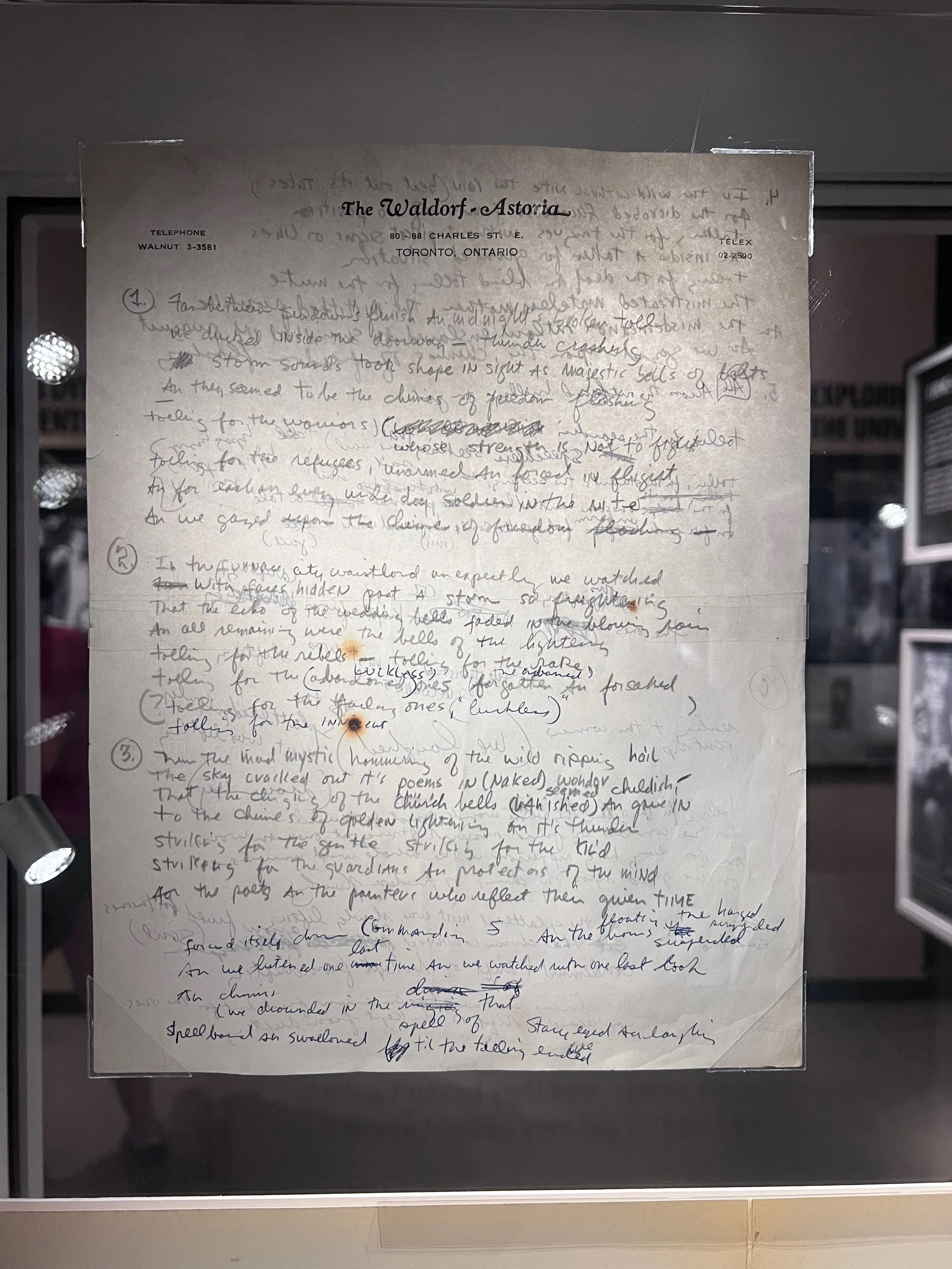
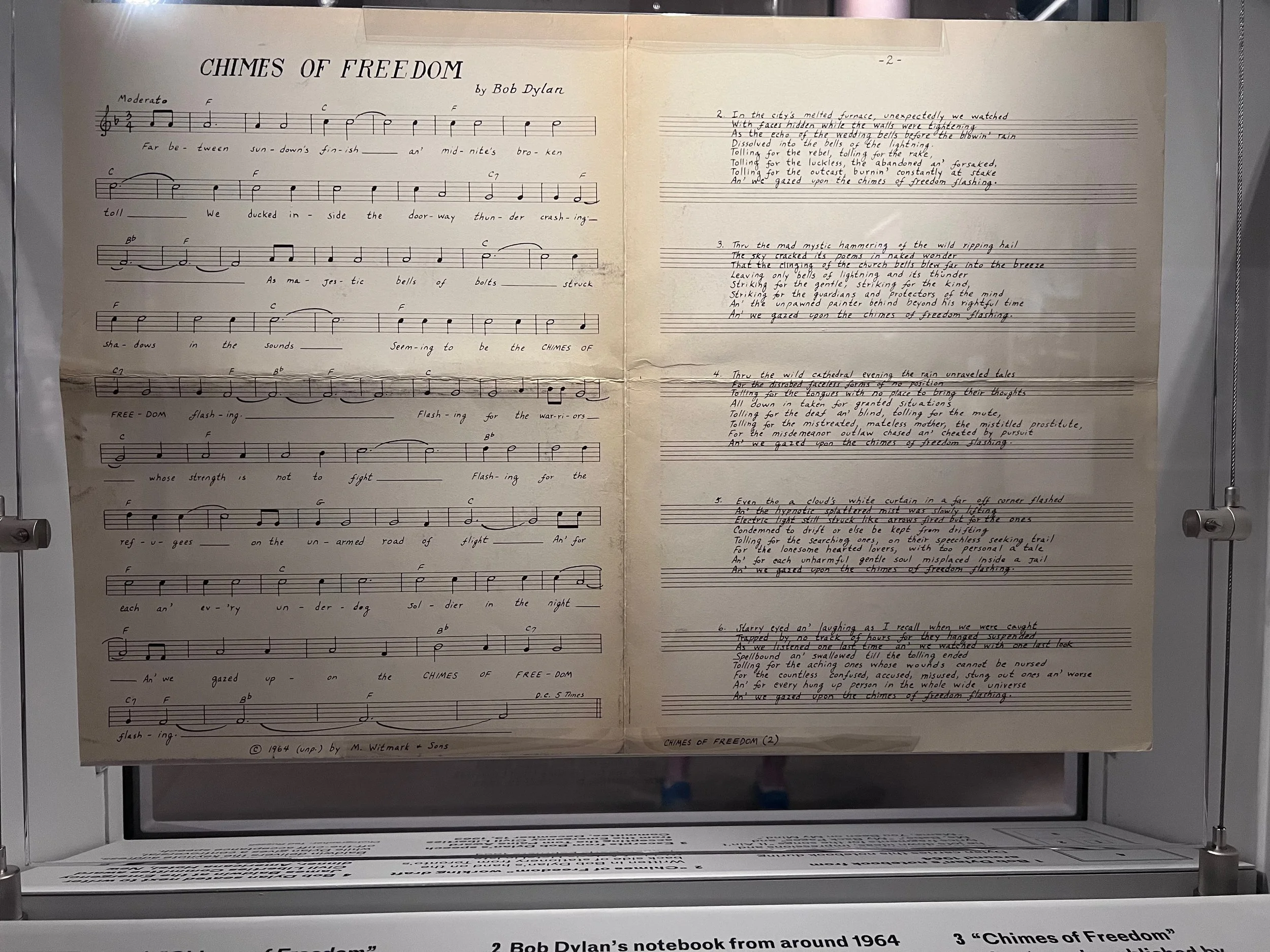
For all of us in the United States, we are living through our own season of disruption, protest, and official story management, and the playbook is not subtle. When an agent kills someone, the first response is not grief. It’s narrative control. When people protest, the response is not to listen. It’s escalation. When the free press reports about the Administration, the FBI raids the house of the Washington Post journalist to dismantle the Fourth Estate. It’s intimidation. The point is to make truth feel expensive, exhausting, and socially risky. The point is to make you doubt your own eyes.
The arc of oppression
And, yes, during my time in Tulsa, I did visit Greenwood Rising. To stand inside this harrowing sanctuary of memory, you realize that America didn’t just bury its history; it paved over it. The exhibits bear witness not only to a past atrocity but also to how easily truth can be reshaped or erased. Greenwood was ambition made visible. Businesses. Families. A district so economically alive it became shorthand for “Black Wall Street,” itself a kind of double-edged compliment. America can only praise Black flourishing by measuring it against white prosperity.
Then, on May 30, 1921, a young Black man named Dick Rowland was accused of assaulting a young white elevator operator, Sarah Page, after an incident in a downtown building. The details were never clean or settled. A rumor, a headline, a whisper of violated white womanhood, and suddenly the city’s anxiety had a script. Rowland was arrested. A mob gathered at the courthouse demanding him. Black men, many of them veterans, came to prevent a lynching. And in the charged space between accusation and accountability, Tulsa chose violence.
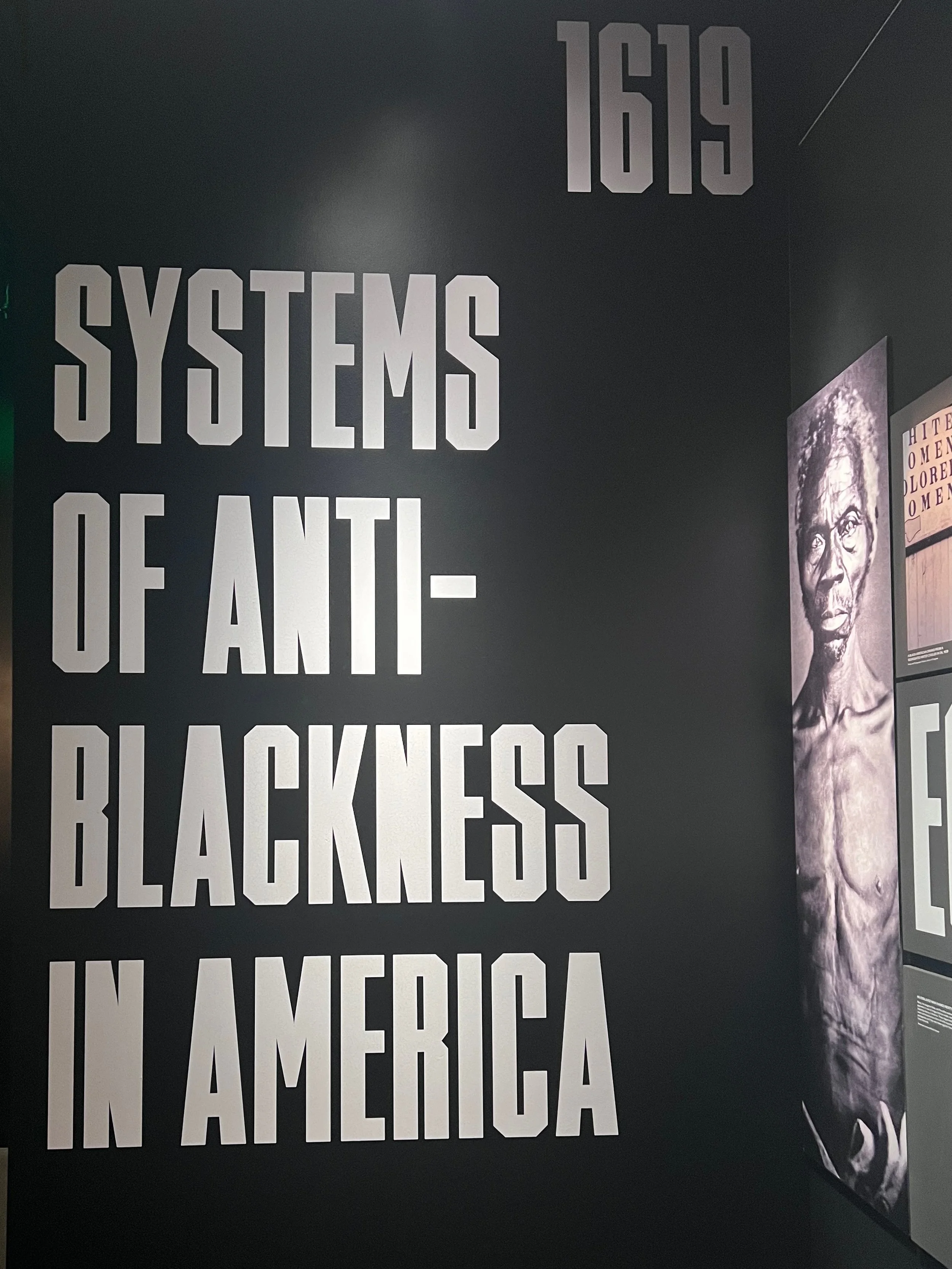
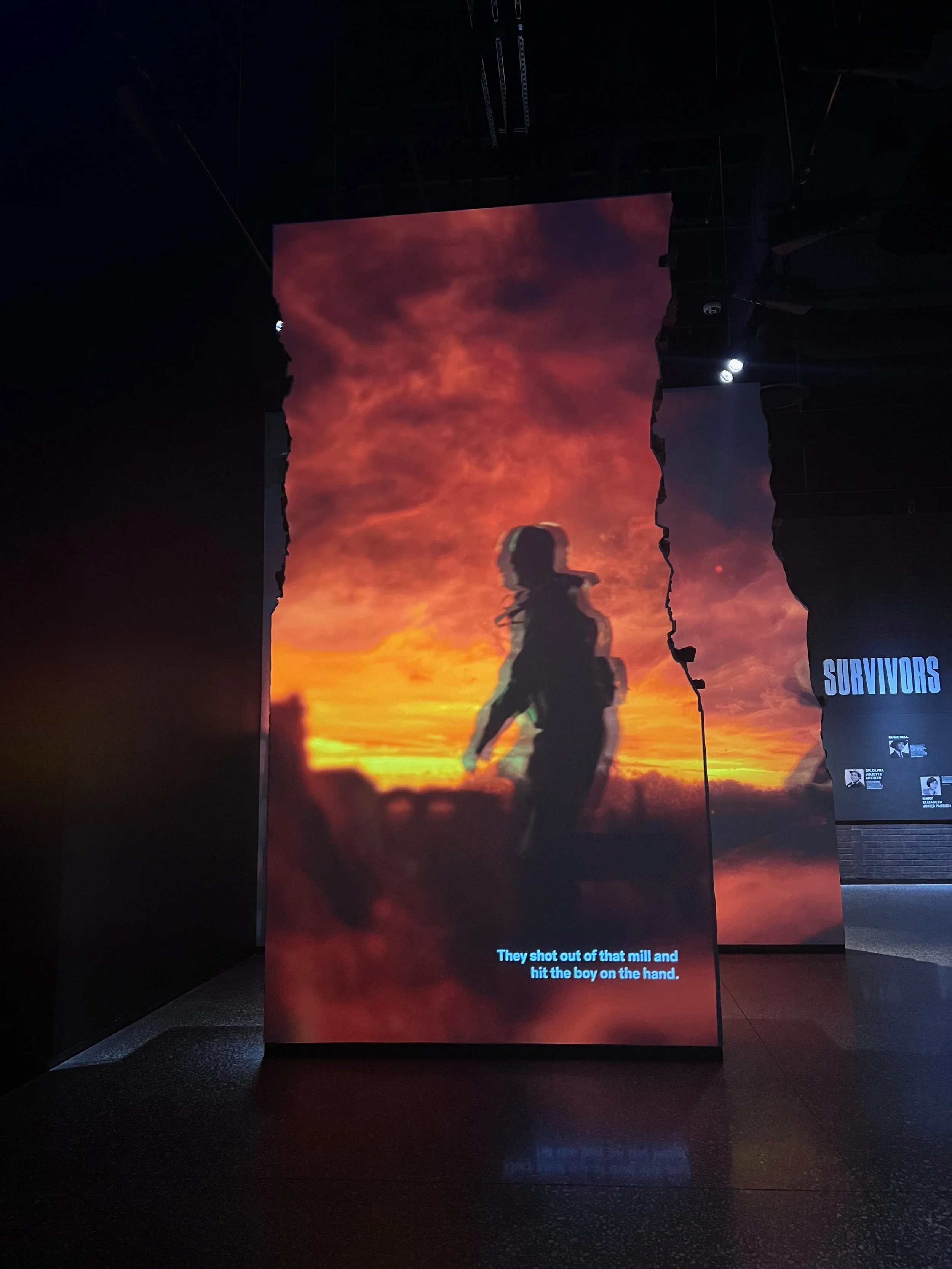
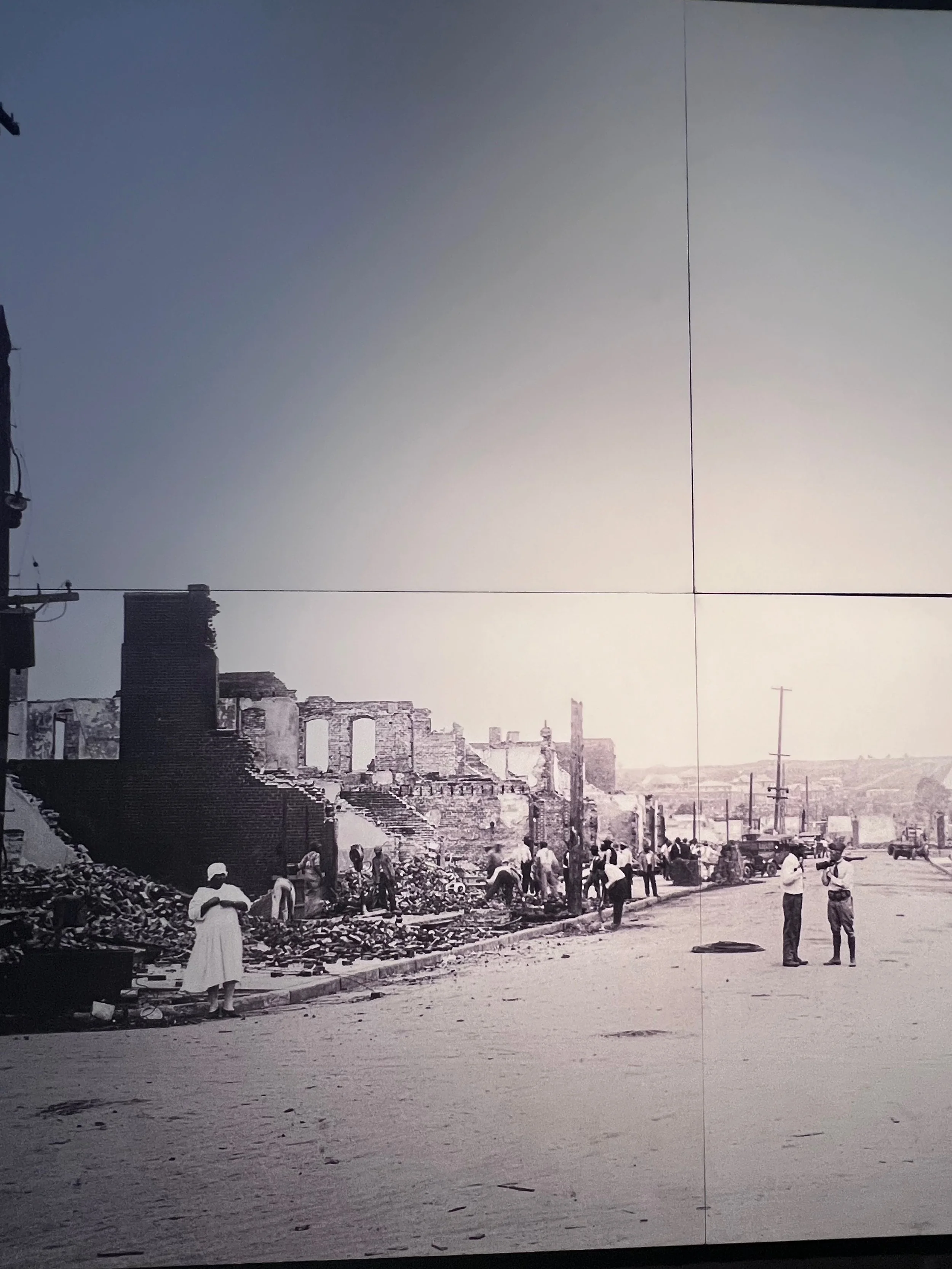
In a matter of hours, 35 city blocks were destroyed. Estimates are that between 150 and 300 were killed, and another roughly 700 were injured. More than 1,256 Black homes were burned, with another 215 looted. And in the aftermath, between 4,000 and 6,000 Black residents were held under armed guard in makeshift camps, as if surviving the fire made them suspect.
The Tulsa Race Massacre did not begin because a single story was true. It began because the story was useful, because it activated an old reflex: that Blackness could be punished preemptively, and that the punishment could be framed as protection.
For decades after 1921, the machine of silence was so effective that the massacre wasn’t even taught in Tulsa schools and beyond. It was one of many parts of our history that I don’t remember ever learning about in public school. The ‘official’ story had won. But a ghost cannot be buried forever; it just waits for someone to build a way for it to speak. This is what Tulsa made plain to me: conscience only survives when it has tools.
The Ghost in the Machine
People use “ghost in the machine” to mean different concepts: a spirit inside a body, a mind inside matter, a glitch in the system, or a hidden force animating the whole thing. Philosophers argue about it. I’m not trying to win that argument. I’m trying to name what I saw.
For me, the ghost is the conscience each of us carries. The internal compass that starts speaking when something feels unjust, broken, or unfinished.
The machine is the set of tools that makes that conscience legible in public. For Guthrie, it was a guitar and a chorus that the country could carry. For Dylan, it was language hammered and rehung until it could hold the weight. And today, as we celebrate Dr. Martin Luther King, Jr., we remember a man who built a machine out of a Black church in Alabama, out of the Montgomery bus lines, and out of the “Letter from Birmingham Jail,” words written on the margins of a newspaper because he refused to let his conscience be silenced by a cell block. For others, it is a camera, a canvas, a sermon, a courtroom brief, a ballot, a protest sign, a mutual aid network, a phone call made when silence would be easier.
And here is the part I cannot unsee now: If truth is negotiable, then your silence is part of the negotiation.
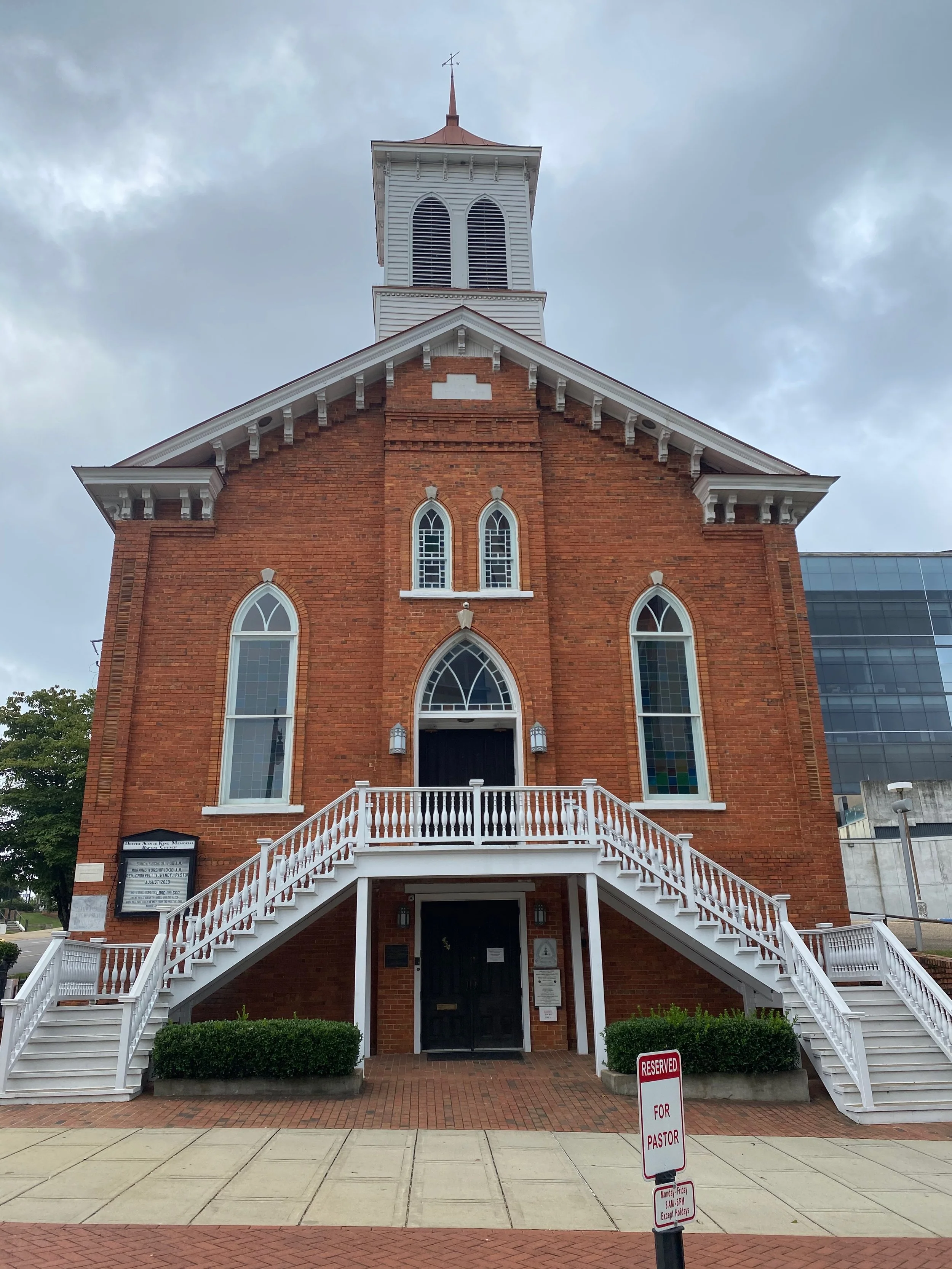
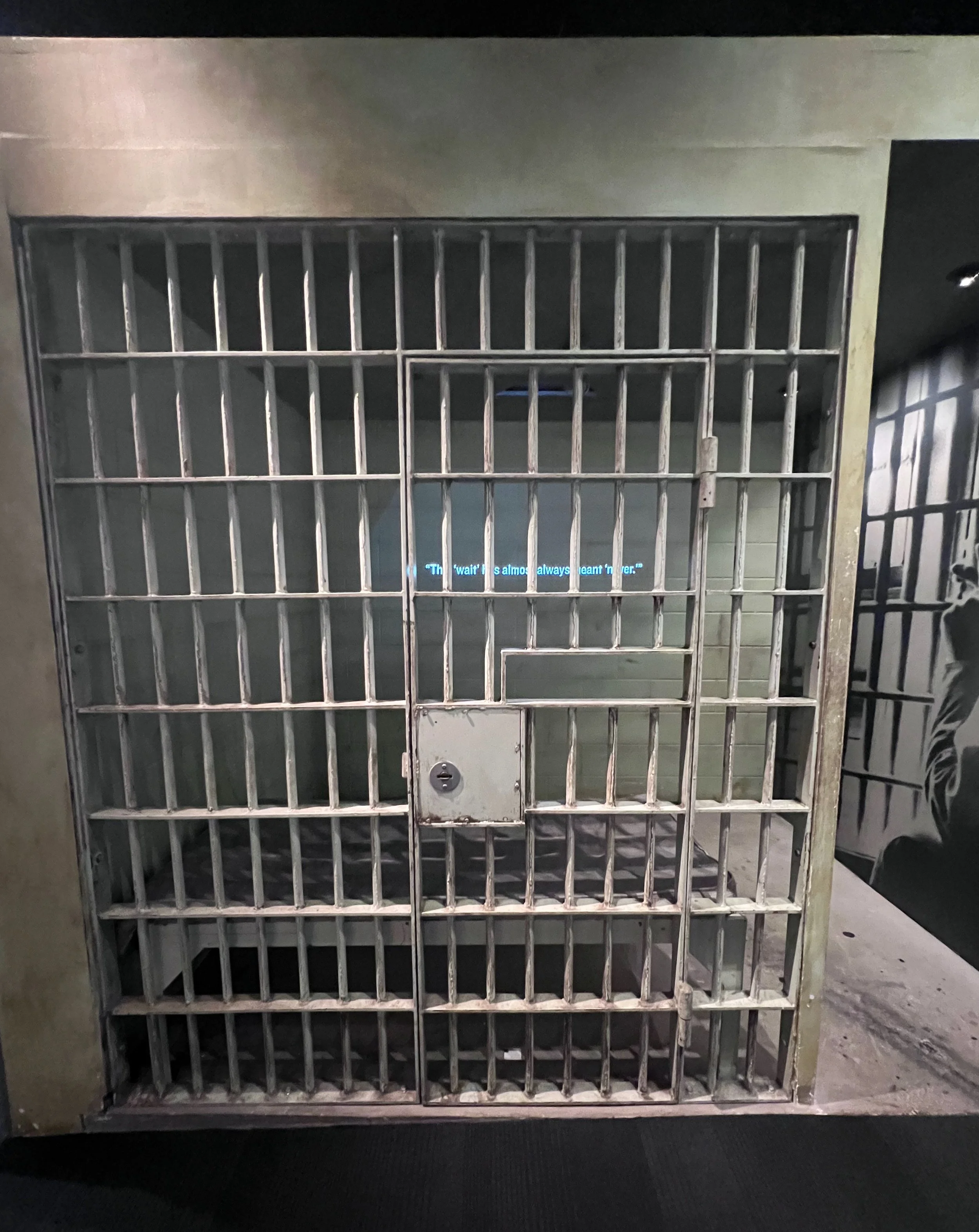
The question is not whether your ghost exists. It is whether you have built a machine capable of carrying its weight into the street.
The ghost is speaking. The machine is waiting.
Further exploration
If you’re interested in going deeper into the museums mentioned in this essay, I encourage you to explore them. Each holds memory, resistance, and conscience in its own way:
Greenwood Rising (Tulsa, OK) History center dedicated to the 1921 Tulsa Race Massacre and the legacy of Black Wall Street.
Woody Guthrie Center (Tulsa, OK) Archival home of Guthrie’s music, activism, and legacy.
Bob Dylan Center (Tulsa, OK) Next door to Guthrie’s, this museum offers an extraordinary look at Dylan’s drafts, notebooks, and evolution as a writer of witness.
National Civil Rights Museum (Memphis, TN) Built around the Lorraine Motel, where Dr. King was assassinated, the museum traces the long arc of the civil rights movement.
Dexter Avenue Baptist Church (Montgomery, AL) The church where Dr. King first preached and helped organize the Montgomery Bus Boycott.
Originally published on Substack on January 19, 2026
