The Physicality of the Line
What Hunger Reveals About America’s Moral Budget
It was morning as I made my way toward downtown El Paso. As I passed the intersection of E. Rio Grande Avenue and N. Campbell Street, I began to see it. The line was well over a hundred deep as it stretched toward Montana Avenue, growing as I continued to walk.
There was no noise, no protest, no sign to explain its purpose. Only a quiet line marked by a deep, weary dignity. Men, women, children, the elderly, families, veterans, the working poor, and the unhoused stand in this line.
I’ve seen these lines wherever I go. One on North LaSalle Street in Chicago. Another on Temple Street beside the New Haven Green. Another on Market Street in Memphis. I could go on. To be clear, I’m not an expert on hunger. There are many around our country with far more insight into this issue and the solutions. My travels across this country have offered a ground-level perspective, far removed from Washington’s discourse, as I explore each new city I call home.
And in every place, there is the same stillness: people suspended between need and shame, between visibility and invisibility. They wait for a box, a meal, or a moment of relief from a grinding, daily terror.
Here, hunger has a name. Hunger has a body. Hunger waits. Hunger stands in line.
The Quiet Math of Survival
While the line is public, hunger is not always visible. Sometimes it lives in small, private moments, in grocery aisles, in the sound of coins counted out one by one, in the quiet math of survival.
I remember standing in a Kroger in Richmond, Virginia, watching a fellow shopper count the coins in his hand to see if he had enough for two cans of soup. Or standing at the checkout line at Family Dollar in Dayton, Ohio, where a mother counted quarters to buy food for her daughter. It was there that I noticed a sign by the register stating that SNAP was accepted, a term I hadn’t heard before.
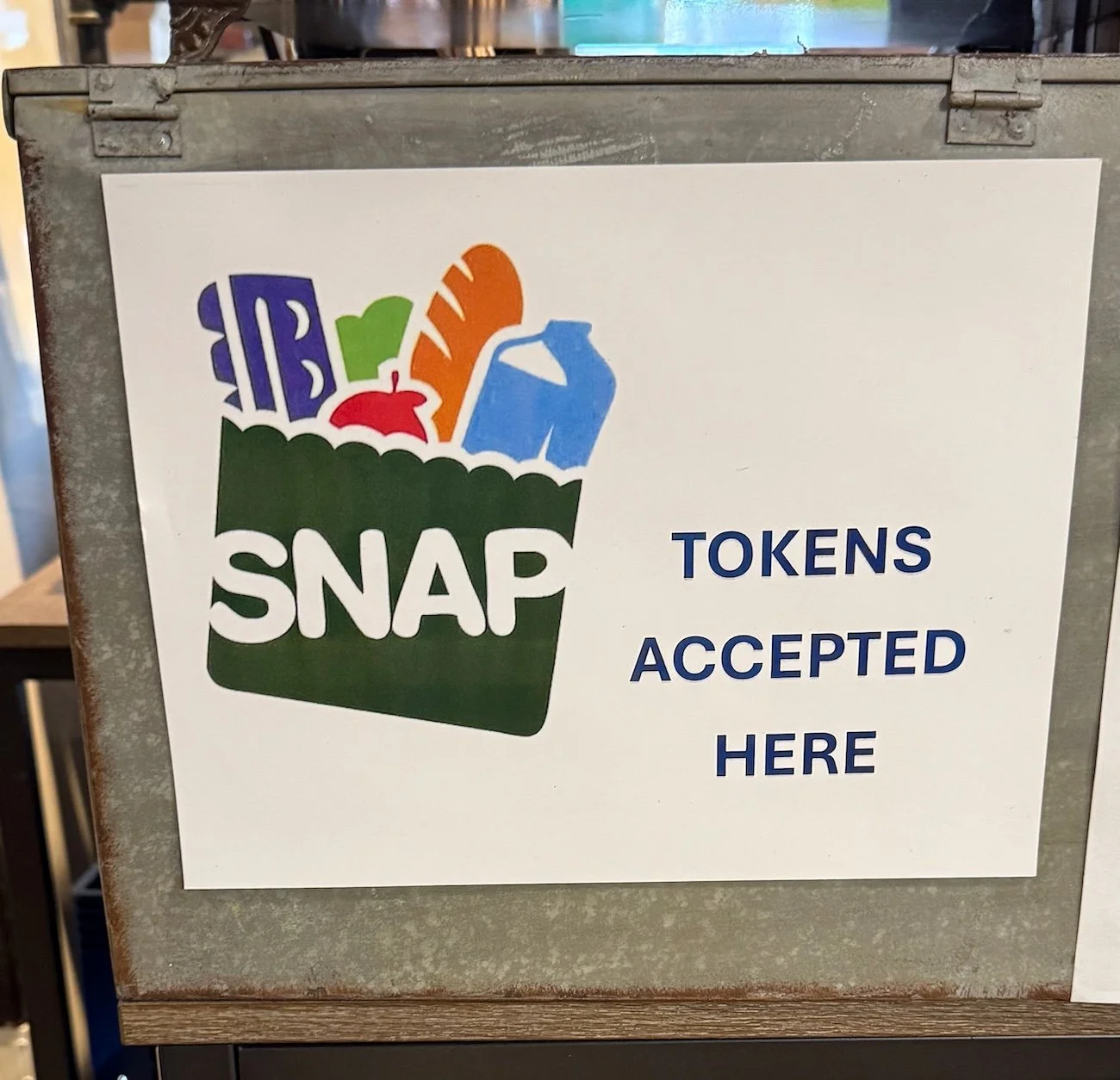
2nd Street Market, Dayton, OH (Michael Holland)
The Politics of Cruelty
The Supplemental Nutrition Assistance Program, or SNAP, is the last barrier between millions of Americans and hunger. It has now become central to the current government shutdown. When conservative commentators or politicians like Senator Rand Paul tweet dismissively about “why we have 42 million people on SNAP,” they are not asking a policy question; they are launching a moral attack.
They are taking 41.7 million human beings and reducing them to a single, weaponized line item on a budget. This rhetoric erases the dignity I witnessed in those food lines and replaces it with a narrative of unworthiness and waste. The fact that these lines exist in a nation defined by unparalleled wealth and abundance is not a logistical failure; it is a structural abandonment.
Erasing the Social Contract
And the hypocrisy of this position, particularly from those who claim a Christian moral purpose, is staggering. They embrace a selective piety, loudly proclaiming their faith while simultaneously moving to cut off the very means of survival for the vulnerable. They have missed the core message of compassion, the moral directive embedded in the story of Christ and the loaves and fishes.
The political rhetoric demands that we see this crisis as a moral failure of the poor, but the data reveal something else: an ideological war against the very idea of a shared safety net. This war found its sharpest expression when Agriculture Secretary Brooke Rollins called the program “so bloated, so broken, so dysfunctional, so corrupt that it is astonishing.”
According to the USDA, the average SNAP benefit is $187 per person per month, barely enough for a week of groceries in most cities. Let’s pause on that: 187 dollars per month, not per week, not per day. Nearly two-thirds of recipients are children, older adults, or people with disabilities. Eight in ten households include at least one such member.
And despite the myths that surround the program, the largest racial group of participants is white Americans, many living in rural areas and small towns where poverty is often hidden but deeply felt.
The rhetoric that paints SNAP as bloated is not about fiscal responsibility. It is about erasing a social contract. By weaponizing myths of dependency and invoking fears of fraud and immigration, even though undocumented individuals are ineligible for benefits, political leaders have turned a lifeline into a target.
The result is not reform but structural self-sabotage, a deliberate act of cruelty that sacrifices the welfare of their own voters at the altar of ideological purity. In truth, hunger decreases by five to ten percentage points among families receiving SNAP, yet eighty-eight percent of participants still face barriers to healthy diets, most often because food prices remain out of reach.
The Measure of Who We Are
Hunger is not only the ache of an empty stomach. It is the tightening of the chest when the cupboard is bare, the quiet panic of a parent pretending they’re not hungry so their child can eat, the daily arithmetic of survival that leaves no room for rest.
It takes very little to join the line. A lost job. A medical bill. A rent increase. The distance between security and hunger is not measured in miles but in weeks.
I wonder if I will stand in that line one day.
And that morning in El Paso, I learned the building’s name: the Kelly Center for Hunger Relief. One of thousands across the country where compassion quietly holds the line against abandonment. In every city, these lines form and reform, silent testaments to our collective failure and the persistence of human dignity. They do not demand attention; they ask only to be seen.
Hunger waits. Hunger stands in line. And in that line, the measure of who we are as a nation is laid bare
Originally published on Substack on November 5, 2025.
